Amidst the rise of social media, the image of a ‘successful’ family seems to have increasingly clear standards. Our timelines are filled with images of harmonious families, romantic couples, high-achieving children, cosy homes, and holidays that appear perfect. Everything looks idyllic, as if there were no conflicts, tears or struggles. Many people then compare their own lives with what they see on their screens. When the reality of their own family life isn’t quite so idyllic, feelings of failure and disappointment arise, and they may even question whether their family is truly blessed by God.
This phenomenon reminds us that people often judge success by appearances. Yet, for believers, the measure of success cannot be separated from faith in Christ. When speaking of a successful Christian family, the fundamental question is not whether that family appears perfect in the eyes of others, but whether the Bible provides the same standard. For when the term ‘Christian’ is applied to a family, the standard by which it is measured must be rooted in the testimony of Scripture.
The Bible Does Not Hide Family Wounds
One of the Bible’s distinctive features is its honesty in portraying human life. Unlike social media culture, which tends to showcase the best aspects whilst concealing failures, the Bible, on the contrary, presents its main characters exactly as they are. The patriarchs of the faith are not portrayed as flawless human beings. Nor are their families.
Ever since the first family in human history, the Bible has shown that family life has never been free from struggle. Adam and Eve received the gift of a suitable partner, yet it was through that very first family that sin entered the world (Genesis 3:6). Their fall not only resulted in humanity’s expulsion from the Garden of Eden, but also left a deep wound within the family. Their eldest son, Cain, killed Abel, his own brother. This story serves as a reminder that family conflict is not a problem that has only emerged in modern times.
A similar struggle is evident in the family of Abraham. As the father of the faithful, Abraham received God’s extraordinary promise. He lived in prosperity, was held in high esteem, and became a key figure in the history of salvation. Yet his life was not without its problems. The long wait for an heir created tension within his household. The arrival of Hagar and the birth of Ishmael actually gave rise to a new conflict between Sarah and Hagar, which ultimately forced Abraham to make a deeply painful decision: to send Ishmael and his mother away. God’s blessing did not erase the reality that his family continued to grapple with complex problems.
The same was true of Isaac’s family. His marriage to Rebekah began with such a beautiful story. Rebekah is described as a beautiful woman with a kind heart. However, the course of their family life revealed another side. Isaac favoured Esau, whilst Rebekah took Jacob’s side. This favouritism led to a rift that forced Jacob to flee his home.
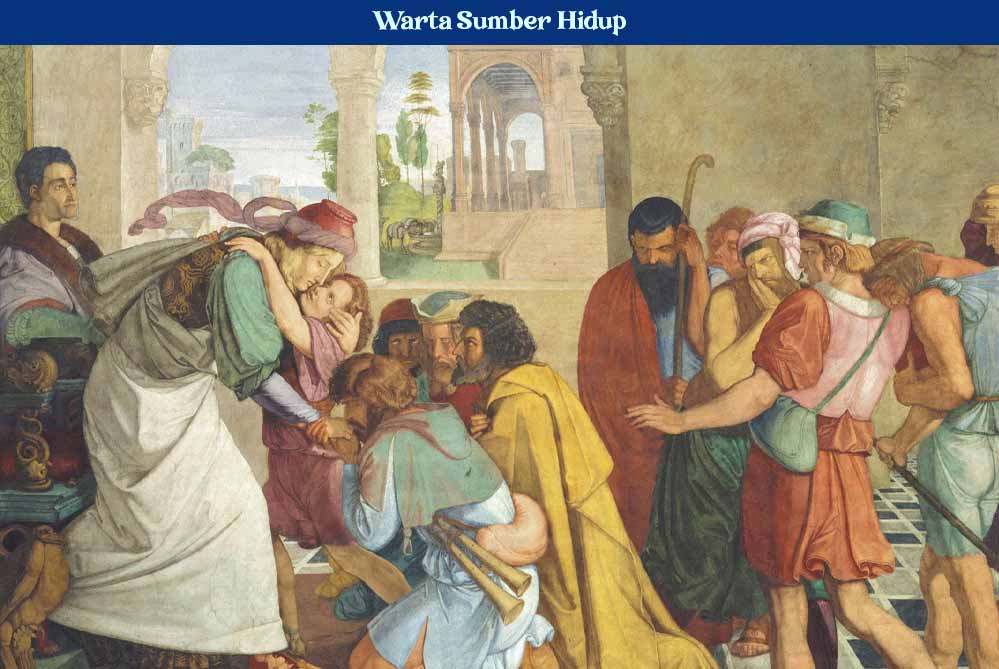
Jacob’s family also faced problems that were no less serious. The rivalry between Leah and Rachel characterised their family life. This tension then spread to the relationships between the children, reaching its peak when Joseph was sold by his own brothers into Egypt. Ironically, the family that became the forerunner of the twelve tribes of Israel was born out of a relationship rife with hurt and jealousy.
The same pattern is evident in the family of the priest Eli. As high priest at Shiloh, Eli held a position of honour. Yet his sons lived in wickedness and abused their priestly office for personal gain. Consequently, God pronounced judgement upon his family and cut off the line of priesthood from his descendants (1 Samuel 2:11–36). A spiritual position is clearly no guarantee that a family will be spared from failure.
David, known as ‘a man after God’s own heart’, also experienced profound family tragedies. Amnon raped Tamar, Absalom rebelled against his own father, and there was even a struggle for the throne amongst his own sons. David’s closeness to God did not mean that his family was spared from conflict and suffering.
Even the family of Joseph and Mary, whom God chose as the home in which the Messiah would grow up, did not lead a trouble-free life. From the time Jesus was a baby, they had to flee to Egypt to escape Herod’s threat. They lived as refugees in a foreign land, then experienced anxiety when Jesus was left behind in the Temple, and ultimately Mary had to witness her Son’s death on the cross. Jesus’ presence within the family did not remove the reality that they still had to endure suffering.
If the entire story is read in sequence, an interesting pattern emerges. There is hardly a single family in the Bible that fits the picture of an ideal family by human standards. They experience failure, conflict, loss, and even very serious sin. Yet it is precisely through these fragile families that God continues to work. In other words, the Bible is not presenting a portrait of perfect families, but rather real families living in a world that has fallen into sin.
What Is Preserved Is Not Perfection, But the Covenant
If that is the case, what exactly is the Bible seeking to teach through these stories?
The answer lies not in their success in building conflict-free families, but in the fact that God continues to maintain His covenant relationshipwith them. It is this common thread that links all the family narratives in the Old Testament. What God sustains is not the perfection of their families, but the continuity of His work of salvation amongst His people.
This principle is clearly evident in the use of the phrase ‘not blotted out’, which appears repeatedly in the Old Testament. For modern readers, genealogies are often understood merely as records of descent. Yet for ancient Israel, genealogies held profound theological significance. Through genealogies, the identity of the covenant people was preserved. Remaining recorded amongst the people of Israel meant continuing to share in the history of God’s work of salvation.
Therefore, when the tribe of Benjamin was on the verge of extinction due to a civil war, the elders of Israel immediately sought a way to ensure that the tribe would continue to have descendants (Judges 21:16–17). They did not merely feel pity for the survivors. The extinction of a single tribe meant a reduction in the integrity of the covenant community. For this reason, they endeavoured to ensure that “no tribe should be blotted out from among the Israelites.” What was being preserved was not merely the biological existence of a tribe, but the continuity of the people whom God had called.
The same meaning is evident in the law concerning marriage to a brother’s widow (Deuteronomy 25:5–6). At first glance, this rule appears to regulate only the family’s inheritance rights. Theologically, however, its purpose is far more profound. A child born of such a marriage is regarded as the successor to the name of the deceased brother “so that his name may not be blotted out from among the Israelites.” Thus, the law serves to preserve the continuity of the covenant people, not merely to maintain the biological line.
Conversely, Psalm 109:12–13 uses the image of “having one’s name blotted out” as the most severe form of punishment. The psalmist pleads that his enemy’s name be blotted out from future generations. This plea is not merely a prayer that someone should have no descendants, but rather that they should lose their place within the community of God’s people. For the Israelites, there was no greater suffering than being cut off from the history of God’s work of salvation.
It is in this light that the stories of the biblical families take on a fuller meaning. Adam failed, but God continued His work through his descendants. Abraham faced family conflict, yet God’s promise was carried forward through Isaac. Isaac, Jacob, David, and even Joseph and Mary experienced various struggles, yet they did not fall outside the scope of God’s work of salvation. Conversely, the family of Eli serves as an example of how unfaithfulness led to God cutting off their line of ministry.
The Measure of a Christian Family’s Success
For ancient Israel, the expression “not blotted out” was closely linked to the continuity of God’s covenant people. Through descent and lineage, a person’s name remained part of the people called and preserved by God. However, in the light of the Christian faith, this meaning does not stop at the continuity of the biological lineage. What is primarily preserved is the continuity of life within the covenant with God—that is, the faithfulness to continue walking in His ways and passing on the faith to the next generation. Therefore, the Christian family is called to be a place where faith in Christ is continually lived out and passed on.
From the entirety of the biblical witness, it is evident that the measure of a Christian family’s success differs from the standards often set by modern society. Success is not measured primarily by material wealth, conflict-free harmony, or the achievements of each family member. Whilst all these are indeed blessings for which we should be grateful, they are not the essence of success according to the Bible.
The success of a Christian family lies in its faithfulness to continue living in the presence of God. They may experience conflict, loss, failure, and even suffering. However, none of this causes them to turn away from God or step outside the scope of His work of salvation. This is the common thread evident in the lives of Adam and Eve, Abraham, Isaac, Jacob, David, right through to Joseph and Mary. They were not perfect families, but they remained under God’s care.
Therefore, families currently facing struggles need not immediately conclude that they are less blessed. The Bible, in fact, shows that almost all the families God has used have gone through difficult seasons. Struggles are not a sign that God’s love is absent. What is far more important is whether, amidst all these struggles, the family continues to direct their lives towards the Lord and does not allow their faith to end with their generation.
Ultimately, a successful Christian family is not one that is able to maintain a perfect image in the eyes of the world. A successful family is one which, by God’s grace, remains faithful as part of the great narrative of His work of salvation. For, according to the Bible, the measure of success is not a life without storms, but rather remaining in covenant with God so that faith continues to grow and is passed on from one generation to the next. That is where the true success of a Christian family lies.
YouTube link: https://youtu.be/Psn0VDWJ8Yw?si=aE36eqlXzeGAmpSV