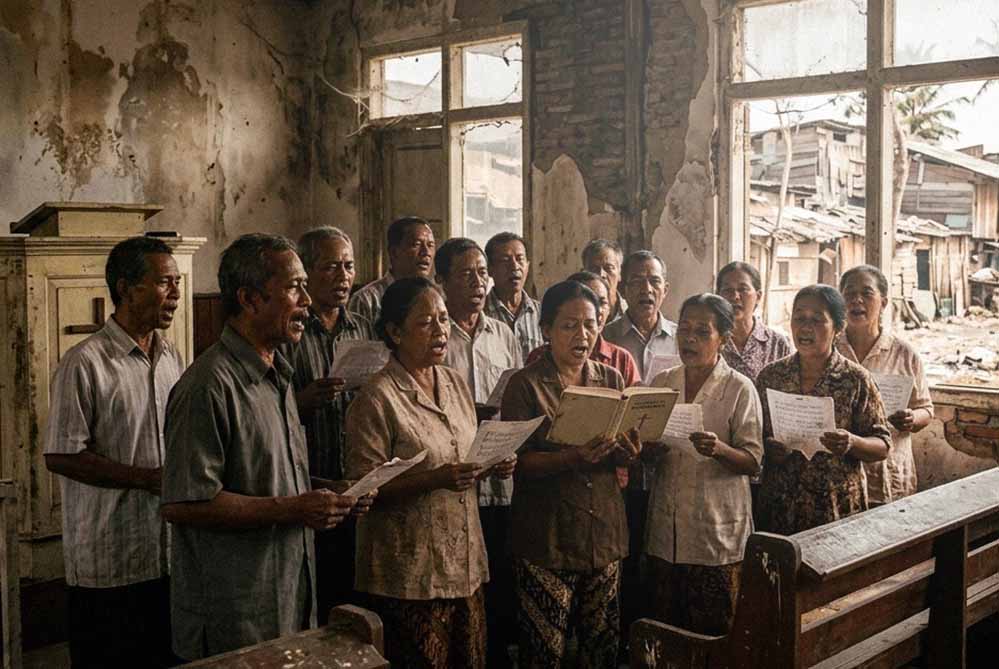
There comes a moment in life when one no longer feels like one is "growing", but only "surviving". Like a relationship that was once warm, but slowly became cold. Or a life plan that once seemed clear, but now only leaves fragments of hope. In the language of psychology, this is often referred to as the experience of "disintegration": when something that once formed our identity collapses, and we don't yet know what will replace it. But it is precisely at such a point, humans begin to learn one important thing, that destruction does not always mean the end. Sometimes it is a quiet space where something new is being prepared.
Isaiah 11:1-16 speaks from that space of destruction. The image of "Jesse's stump" is a picture of something that seems finished. The great tree has been cut down, leaving only a stump that no longer promises anything. It is a picture of the house of David losing its glory. A nation that was once great, but now lives in the shadow of defeat, exile, and loss of direction. Yet in the midst of this situation, Isaiah prophesied a new possibility: from the stump came a shoot. From what seemed dead, life was born. This condition is close to the experience of post-traumatic growth, which is growth that is not born from comfort, but from processed wounds. A new identity does not emerge by erasing the past, but by reorganising its meaning.
Interestingly, this budding brings not only "structural restoration", but also "inner restoration". God's Spirit is described as working in its fullness: wisdom, understanding, counsel, strength, knowledge, and the fear of the Lord. It is a picture of a man who is whole again within himself. And from that wholeness comes justice. The weak are no longer excluded, the poor are no longer neglected. Even nature is described as being restored to a space of peace. It is as if the whole of creation is being "reunited" from its long fragmentation.
Friends of the Bible, there may be parts of our lives that feel like “stumps”, no longer what they once were, no longer as strong as before, perhaps even seeming useless. But these words remind us that in God's logic, what seems to end is never really finished. It can be a new starting point. God himself will lead us from brokenness to wholeness. Let us learn, then, to make space for God to regrow what seems lost, in ways that may not always be the same as before, but bring a deeper wholeness.